

Studio Journal | April Issue 2026

The Studio’s Letter
|
Hi from South Africa, What a joy it has been to return to this country. There is such a richness to it, a sense of life, vibrancy, art, and culture that feels incredibly refreshing.This trip has taken us through some of the most beautiful parts of Stellenbosch, Franschhoek, and Paarl, where we’ve spent time visiting studios, meeting artists, and stepping into spaces that hold a real appreciation for art and craftsmanship. Along the way, we’ve had the opportunity to connect with private estates, galleries, and prospective collectors, often over something as simple as a glass of wine and a bit of biltong. One of the more memorable moments came on ‘Last Thursday’ in Paarl. The town celebrated 100 years of the Afrikaans language by opening itself up to display heritage art and photography, music, and storytelling. The galleries and chapels stayed open late, people wandered and admired, and everyone was welcomed, even if they didn’t speak a single word of Afrikaans. We found ourselves standing beside a fire with a glass of Roodeberg, talking with people we had only just met, conversations that started small but quickly became something more. By the end of the evening, strangers had become friends. It was simple, but it stayed with us. The experience served as a reminder that the most meaningful connections don’t come from trying too hard. They come from being present, from taking the time to engage, to listen, and to share space with others. And from that place, everything else seems to follow naturally. Relationships form, and from there, opportunities and business begin to flow in a way that feels aligned. Amidst all of this, we also reached a milestone for the studio. This trip has really been about exploring what is possible, taking meetings, having conversations, and allowing things to unfold without forcing direction. And my goodness, we are excited to see where it leads.
With love, The Robertsons |

|
Babylonstoren is experienced from within, where you find yourself inside the artwork, formed through nature’s stone and timber rather than placed upon it. The garden is composed as a grid-based installation, where seasonal change becomes the exhibition cycle and planting is treated as colour fields, reminiscent of European gardens yet softened by the Cape’s natural light. There is no visual overcrowding, only open breathing space between elements, creating a sculptural narrative that begins to feel almost mythological in its presence. A restrained palette of soft white Cape Dutch buildings recedes into the background, allowing light itself to act as a primary design element. Imperfection is not corrected but held, and craft is never concealed, remaining visible in a way that aligns with high-end contemporary art thinking.It has become our favourite place in South Africa, somewhere we continue to return to, not just for what it is, but for how it makes you see. |

|
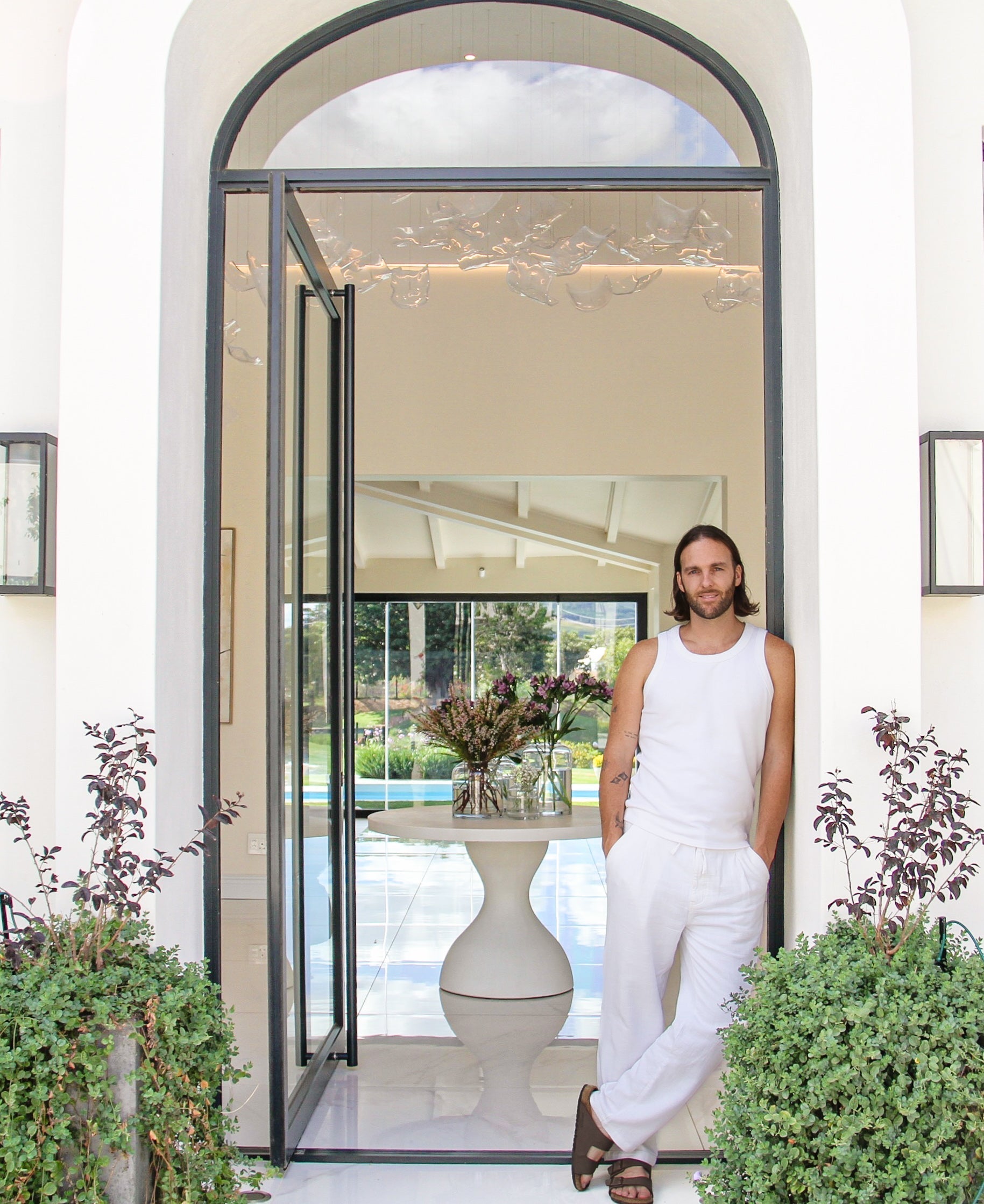
Introducing, for the first time, a project that has been in the making for quite some time, ROBERTSONKUR’s first sculpture, Waar Blomme Dryf (Where Petals Drift). This suspended glass work resides in the Winelands of South Africa, within a private collector’s home, where the space called for something large and unconventional. The room, finished entirely in white, was conceived as a blank canvas, allowing the work to sit as the defining gesture within it. Rather than settling for a chandelier, we designed something more expressive, a piece that would inhabit the volume of the space, drawing the eye upward while introducing movement and visual interest within a purpose designed environment. From this, the idea of a 5 by 3 metre floating field of petals began to take form. The process began through sketching and design, eventually arriving at a direction where the peony would not be expressed literally, but instead through its underlying language of form, movement, and structure. In collaboration with local glassblower David Reed, the concept was brought into material. A glass vessel was first formed, then carefully cut to produce individual petals, each carrying its own variation and subtle imperfection. To map the composition, sculpted styrofoam forms were used to establish spacing, depth, and suspension levels before moving into the final installation. The work exists in a constant state of tension and suspension, while still allowing breath, a moment of stillness, as if a falling petal has been frozen in time. During the day, natural light moves across the surface of the glass, refracting into an array of soft rainbow tones that shift with the sun. By night, focused spot lighting takes over, creating a dance between light and shadow as the petals extend beyond their physical form, casting reflections across the walls and floor. In this way, the sculpture unfolds not only in space, but throughout it. |


|
Land and Sea forms part of the ongoing Peony Garden Collection, a body of work rooted in the belief that we create because He created. Inspired by creation, this piece explores origin, beauty, and divine order through floral abstraction. Set against a dark, immersive background of rusted maroons and earthen warmth, suggestive of light first entering darkness, expansive gestures of blue and green evoke the elemental language of land and sea. The flower structure remains present but it is stretched toward something more symbolic, a meditation on origin, separation, abundance and order. Land and sea stands as a contemplative work on beginnings and what it means for beauty and life to emerge from obscurity and for form to arise where there was once only void. |


1 comment
Love it Kurt 👏🏼👏🏼👏🏼☺️
Maria Varjacic
Leave a comment
This site is protected by hCaptcha and the hCaptcha Privacy Policy and Terms of Service apply.